


Macau Millennium College Supports the Release of the Local Development Index for the Integration of Industry and Education in China (2025) Blue Book in Shenzhen
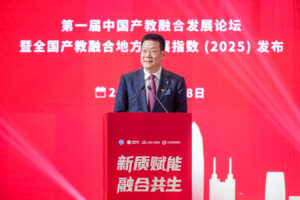
On 18 December 2025, the First China Industry-Education Integration Development Forum was held in Shenzhen, where the Local Development Index for the Integration of Industry and Education in China (2025) Blue Book was officially released. Professor Zhong Weihe, Rector of Macau Millennium College (“MMC” or the “College”), attended the launch ceremony and delivered a speech.
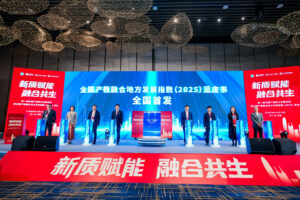
In his speech, Professor Zhong said the core of industry-education integration lies in using mechanism innovation to transform educational strengths into advantages in talent development and innovation, thereby better supporting high-quality development and the building of a modern industrial system. He noted that industry-education integration is shifting from an education-supply-led approach to one driven more strongly by industry demand, and from relatively static programme structures to more flexible and open competency-based development. He stressed the need to improve talent-development standards oriented towards industry needs, strengthen platforms for university-enterprise co-training, and enhance the supporting institutional framework, so as to promote deeper alignment among the education chain, talent chain, industry chain and innovation chain. Against the backdrop of digital and intelligent technologies reshaping industries and talent skill structures, he added, industry-education integration should make full use of such technologies to enable more precise matching between industry demand and talent development. He also called for the development of city-level industry-education consortia and sector-based industry-education communities, alongside mechanisms that facilitate two-way mobility of personnel between universities and enterprises and fair sharing of outcomes, to gradually build a stable, collaborative, efficient and sustainable ecosystem for industry-education integration. He mentioned that the Blue Book, by establishing a systematic and quantifiable evaluation framework, provides an important reference for localities to deepen industry-education integration and to refine policy decisions and implementation pathways, helping to raise industry-education integration to a higher quality and standard.
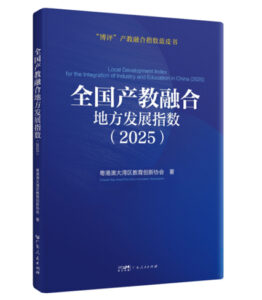
As China’s first research outcome to carry out systematic, quantitative monitoring of industry-education integration levels across major cities, Local Development Index for the Integration of Industry and Education in China (2025) is intended to address gaps in the country’s industry-education integration in terms of standardisation, systematisation, and quantifiable monitoring and evaluation mechanisms, promote effective alignment among the education chain, talent chain, industry chain and innovation chain, and facilitate coordinated progress in education-prioritised development, talent-led development, industrial innovation and high-quality economic growth.
The Blue Book was produced by the Guangdong-Hong Kong-Macao Greater Bay Area Education Innovation Association, together with professionals from a number of universities, research institutions and technology enterprises, through joint research, monitoring and analysis. As a member of the Blue Book’s Expert Advisory Committee, Professor Zhong Weihe has led MMC in actively participating in related research and support work. The College continues to follow national progress in developing local evaluation systems for industry-education integration and, drawing on its exploration and experience in talent development, industry-education collaboration and practice-based teaching, supports the sustained advancement of research on deeper integration between education and industry.
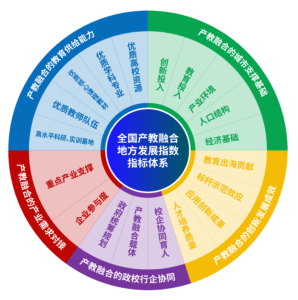
The research primarily focuses on three core components: Index development, index monitoring, and index analysis and evaluation. The research team conducted a systematic review of 35 key documents at the national and provincial levels issued between 2017 and 2025, and developed an indicator system for the Local Development Index for the Integration of Industry and Education in China, comprising five first-level indicators, 19 second-level indicators, and 60 third-level indicators (observation points). The index system covers five key dimensions of industry-education integration: A city’s foundational support, education supply capacity, alignment with industry demand, government-university-industry–enterprise collaboration, and innovation outcomes. A weighting approach that combines Analytic Hierarchy Process (“AHP”) and the Entropy Weight Method (“EWM”) was adopted to balance expert judgement with data objectivity. For the first round of monitoring, the research selected 36 major cities nationwide where industry-education integration is relatively well-established and where data are publicly available, including four municipalities directly under the Central Government, 27 provincial capitals, and five cities under separate state planning, among which 15 are sub-provincial cities. All data were sourced from provincial and municipal statistical yearbooks, government gazettes and government work reports, as well as information platforms of the Ministry of Education and other relevant national authorities, using information available up to the end of 2024, to ensure reliability and traceability.
Indicator System for the Local Development Index for the Integration of
Industry and Education in China
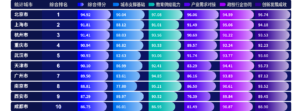
Top 10 City Scores in the Local Development Index for the Integration of
Industry and Education in China (2025)
According to the comprehensive monitoring results, the top 10 cities in the Local Development Index for the Integration of Industry and Education in China (2025) are, in order: Beijing, Shanghai, Hangzhou, Chongqing, Wuhan, Tianjin, Guangzhou, Nanjing, Xi’an, and Chengdu. All 10 recorded overall scores of above 86, forming the national “first tier” of local industry-education integration development. From a regional perspective, the results show a clear pattern: The eastern region continues to lead, while key western cities are gaining momentum and the central region remains on a solid footing. Established front-runners such as Beijing and Shanghai stand out for their strong overall performance, while key western cities including Chongqing, Xi’an and Chengdu rank among the top 10. Wuhan’s robust results further underscore the central region’s steady performance, pointing to a sustained catching-up trend in the west.