-
About MMC

-
News & Updates
-
Organisation
- Academic Units
- Department of Digital and Intelligent Technology
- Department of Management
- Department of Smart Tourism
- Department of Cross-Border E-Commerce
- Department of Digital and Intelligent Teacher Education
- Department of Digital and Intelligent Language Services
- Continuing Education Centre (MMC Silver Age Academy)
- Research Units
- Cross-Border Data Research Centre
- Cross-Border Cybersecurity Research Centre
- Macao Manufacturing Supervision Research Centre
- Research Centre for the Development of Teachers’ Digital Literacy
- Cross-Border BeiDou Application Research Centre
- Digital Language Services Research Centre
- The Center for China-Portugal Cooperation and Tourism Economy Research
- Administrative Units
-
Academic Research
-
Studying@MMC
-
導航


-
Organisation
-
Academic Units
- Department of Digital and Intelligent Technology
- Department of Management
- Department of Smart Tourism
- Department of Cross-Border E-Commerce
- Department of Digital and Intelligent Teacher Education
- Department of Digital and Intelligent Language Services
- Continuing Education Centre (MMC Silver Age Academy)
-
Research Units
- Cross-Border Data Research Centre
- Cross-Border Cybersecurity Research Centre
- Macao Manufacturing Supervision Research Centre
- Research Centre for the Development of Teachers’ Digital Literacy
- Cross-Border BeiDou Application Research Centre
- Digital Language Services Research Centre
- The Center for China-Portugal Cooperation and Tourism Economy Research
- Administrative Units
-
Academic Units
Research by Professor Zhong Weihe, Rector of Macau Millennium College, Published in the Inaugural Issue of Translation and Global Communication
Recently, a research paper by Professor Zhong Weihe, Rector of Macau Millennium College (“MMC” or the “College”), entitled “Conceptualizing a 3C Model for National Image Shaping from the Perspective of Language Services: Cross-Cultural Awareness, Counter-Framing, and Corpus Optimization”, was published in the inaugural issue of Translation and Global Communication. According to the journal’s table of contents, the paper was published in the “Global Communication & Strategy” section of Volume 1, Issue 1, 2026, as the first research article in this section.
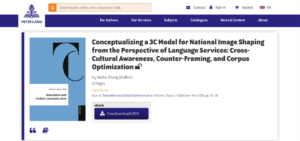
Set against the backdrop of globalisation, the paper focuses on the shaping of national image and examines its underlying logic from the perspective of language services. It argues that national image is an important component of a country’s soft power, while language services, as a vital bridge between a nation and the wider world, play a significant role in shaping how that nation is perceived internationally. Building on the two traditional pathways of national image formation, namely “self-shaping” and “other-shaping”, the paper proposes the concept of “AI-mediated shaping”, suggesting that the development of generative artificial intelligence (“AI”) is driving changes in the model of national image shaping.
On this basis, the paper develops a 3C Model for national image shaping, comprising Cross-Cultural Awareness, Counter-Framing and Corpus Optimization. The paper argues that this model is intended to promote the precise communication and effective construction of national image at the emotional, factual and semantic levels, offering both theoretical insights and practical reference for national image shaping in the new media environment.
The main body of the paper further elaborates on the three dimensions of the 3C Model. First, in the process of self-shaping national image, “Cross-Cultural Awareness” helps prevent cultural misreading in translation and international communication. Second, in response to external narratives, “Counter-Framing” helps address and reconstruct international discourse that may involve bias or misunderstanding. Third, as AI becomes increasingly involved in content generation, “Corpus Optimization” helps improve the semantic accuracy, cultural sensitivity and cross-contextual appropriateness of generated content.
Language services have long been one of the key academic and talent-development priorities of MMC. In recent years, the College has advanced discipline building, academic exchange and research exploration in areas such as digital-intelligent language services, international communication, cross-cultural exchange and AI-empowered education. It has actively promoted the integration of language service research with contemporary issues, social needs and international communication practice.
Looking ahead, MMC will continue to build on its academic strengths in language services and cross-cultural exchange, support faculty members in conducting high-level academic research, and promote the publication of more research outcomes on international academic platforms. Through these efforts, the College will contribute its expertise to the development of the language service discipline, the enhancement of international communication capacity, exchange and mutual learning between Chinese and foreign civilisations.