


Macau Millennium College Holds Lecture on “Digital-Intelligent Exploration of Chinese Cultural Genes and Mutual Learning among Civilisations” and the “Seminar on the Development of the Macao Branch of the Chinese Aestheme Project”
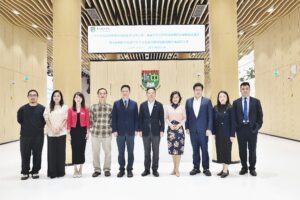
On 24 April 2026, Macau Millennium College (“MMC” or the “College”) held a special lecture on “Digital-Intelligent Exploration of Chinese Cultural Genes and Mutual Learning among Civilisations” and the “Seminar on the Development of the Macao Branch of the Chinese Aestheme Project”. Professor Xiang Yong, Dean of the Institute for Cultural Industries at Peking University, was invited to deliver the lecture. Guests from the Macao SAR Government, higher education institutions and media organisations attended the event, joining in in-depth discussions on the digital-intelligent transformation of Chinese culture and the development of Macao as a platform.
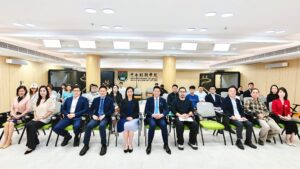
The guests attending this lecture and seminar included: Hoi Chi Kei, Acting Director of the Division of Tertiary Educational Cooperation and Exchange of the Education and Youth Development Bureau; Lam Kin Meng, Head of the Division for Research and Planning of the Cultural Affairs Bureau of Macao; Lam Iok Fong, Director of the Centre for Macau Studies, University of Macau; Wong Un In, Associate Dean of the Faculty of Humanities and Social Sciences, Macao Polytechnic University; Zheng Jiawei, Director of the Macao Branch of China News Service; and representatives of MMC, including Rector Professor Zhong Weihe, Vice Rector Wang Lifei, Assistant Rector Huang Hua and Professor Chen Weiming.
Professor Zhong noted that digital-intelligent technologies are reshaping the landscape of knowledge production and cultural communication, opening up new pathways for the preservation, integration, transformation and global dissemination of fine traditional Chinese culture. As a vehicle for interpreting the inner logic of Chinese culture, “cultural genes” have become a key part of China’s national cultural strategy through their systematic organisation and digital communication. Macao, positioned by the country as “a base for exchange and cooperation where Chinese culture is the mainstream and diverse cultures coexist”, has unique advantages built on the long-standing interaction and integration of Chinese and Western civilisations. It has always stood at the forefront of cultural exchange between China and other countries and plays a unique role in serving the national cultural development strategy.
Professor Zhong introduced that, rooted in Macao and serving the country’s overall development, MMC has, in recent years, focused on its “Digital Intelligence +” educational strategy and continued to promote the integration of the humanities and social sciences with digital-intelligent technologies. The College has offered courses in digital-intelligent language services, digital-intelligent technology, smart tourism and entertainment management, and digital-intelligent teacher education, cultivating interdisciplinary talent with both a grounding in the humanities and digital capabilities. The Macao Branch of the Chinese Aestheme Project and the Macao Digital-Intelligent Innovation Laboratory for Chinese Cultural Genes will systematically organise Macao’s Chinese aesthetic resources, build a structured and computable cultural gene bank, and explore new pathways for integrating large models with cultural content. This will help further enhance the international communication impact of Macao’s Chinese cultural resources.
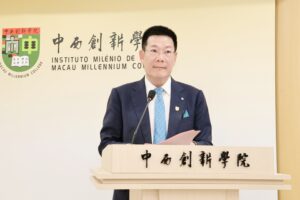
In the special lecture, Professor Xiang Yong spoke on “Digital-Intelligent Exploration of Chinese Cultural Genes and Mutual Learning among Civilisations: The Development Vision for the Macao Branch of the Chinese Aestheme Project”. Focusing on the country’s “AI +” initiative and cultural digitalisation strategy, he systematically explained the theoretical connotations, technological pathways and practical directions of the digital-intelligent transformation of Chinese cultural genes.
Professor Xiang pointed out that digital-intelligent technologies provide new support for the systematic organisation, structured expression and cross-cultural communication of Chinese cultural resources, while “cultural genes” help deepen understanding of the inner logic and generative mechanisms of Chinese culture. Drawing on Professor Ye Lang’s important proposition that “beauty lies in imagery”, he explained the image-based thinking, freehand spirit, tradition of implication and the spirit of harmony between humanity and nature in Chinese aesthetics, and proposed a practical direction for decoding Chinese aesthetic genes through digital-intelligent technologies and reconstructing an Eastern system of aesthetic expression.
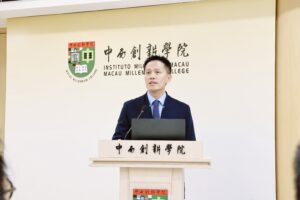
Professor Xiang gave a detailed account of the practical explorations by the Institute for Cultural Industries at Peking University in developing the “Chinese Aestheme Project” and the “Luo Shen Fu Intelligent Creation Tool”. He noted that the team has built an aesthetic indicator system covering nine major categories and more than 300 secondary and tertiary entries, advancing hierarchical annotation of Chinese aesthetic genes, multimodal large model training, and the research and development of cross-modal intelligent generation technologies. The generated examples displayed on site, including Chinese paintings, calligraphy and landscape paintings, vividly demonstrated the possibility of artificial intelligence moving from artistic “formal resemblance” to “spiritual resonance”, showing its understanding and reproduction of traditional aesthetic norms, the brushwork, spirit and resonance of renowned masters, and the spirit of Chinese aesthetics.
Regarding the development of the Macao Branch of the Chinese Aestheme Project, Professor Xiang pointed out that Macao, as an important node of cultural exchange between China and the West along the Maritime Silk Road, has accumulated rich and diverse cultural resources. These resources can enrich the content of the Chinese Aestheme Project and help expand the international communication space for Chinese culture. Looking ahead, Macao should give full play to its strengths as a hub connecting China and the West and linking the domestic and international spheres, promote industry-academia-research collaboration and the practical application of digital-intelligent achievements, and explore new pathways for digital-intelligent technologies to empower Macao’s cultural inheritance, urban aesthetic development, and mutual learning among civilisations, enabling the spirit of Chinese aesthetics to shine with renewed vitality in the digital-intelligent era.
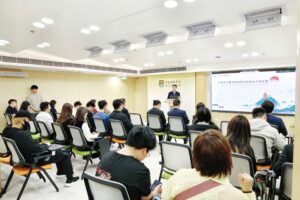
The “Seminar on the Development of the Macao Branch of the Chinese Aestheme Project” featured in-depth discussions on platform positioning, development pathway and collaboration mechanisms. Guests at the seminar agreed that Macao has unique advantages in the national cultural development strategy and should make full use of its positioning as “one base” to play a more active role in the digital-intelligent transformation and international communication of Chinese culture.
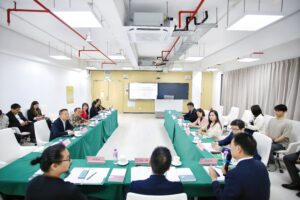
The Macao Branch of the Chinese Aestheme Project and the Macao Digital-Intelligent Innovation Laboratory for Chinese Cultural Genes will rely on the College’s “Digital Intelligence +” development strategy, integrate Macao’s and related Chinese aesthetic resources, advance data organisation, knowledge modelling and large model applications, and explore pathways for transforming cultural resources into academic research, artistic creation and cultural industries. It aims to become a comprehensive innovation platform integrating research, application and communication.
Experts at the seminar offered suggestions on the development of the platform, including strengthening the collection and systematic organisation of local cultural resources, promoting collaboration among higher education institutions, improving coordination mechanisms with cultural administration departments, and expanding international communication pathways targeting Portuguese-speaking countries.
The lecture and seminar deepened participants’ understanding of Chinese cultural genes and digital-intelligent transformation, while also building consensus and clarifying the direction for the development of the Macao Branch of the Chinese Aestheme Project. In the future, MMC will continue to be rooted in Macao and serve the country, promote the innovative development and international communication of Chinese culture in the digital age, and help Macao become an important hub for bringing fine traditional Chinese culture to the world.