


Macau Millennium College Hosts the “Training Programme on Language Competence, Literacy Enhancement and Assessment for University Teachers and Students in the Guangdong–Hong Kong–Macao Greater Bay Area”
On 15 May 2026, the “Training Programme on Language Competence, Literacy Enhancement and Assessment for University Teachers and Students in the Guangdong–Hong Kong–Macao Greater Bay Area”, supported by the Education Fund of the Macao SAR Government and hosted by Macau Millennium College (“MMC” or the “College”), was successfully held at the College’s Taipa Campus. Under the theme “Digital-Intelligent Empowerment, Precision Assessment”, the programme focused on frontier issues including language competence development in the age of artificial intelligence (“AI”), digital-intelligent transformation in education, and innovation in language assessment. It brought together experts, scholars, representatives of faculty members and students from a number of higher education institutions to explore new directions and pathways for the high-quality development of university language education.
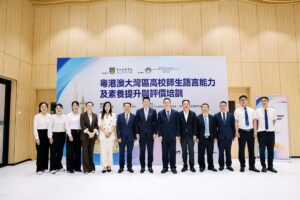
The event was attended by Lai Hei, Acting Head of Division of the Education and Youth Development Bureau (“DSEDJ”); Professor Zhong Weihe, Rector of MMC; Professor Wang Lifei, Vice Rector of MMC; Fang Yingsheng, Secretary of the Party Committee of Guangdong Songshan Polytechnic; Xu Yaohong, Vice President of Guangdong Songshan Polytechnic; Professor Zhang Yunfeng, Dean of the Faculty of Languages and Translation of Macao Polytechnic University; Professor Ren Wei of Beihang University; Professor Li Heng of Sichuan International Studies University; Professor Li Li of Macao Polytechnic University; Associate Professor Gao Yang of Xi’an Jiaotong University; Associate Professor Liu Aihua of Macao Polytechnic University; and Assistant Professor Malila Prado of Beijing Normal-Hong Kong Baptist University. Participants engaged in in-depth exchanges on language education, AI, digital-intelligent transformation in education, multimodal intelligent assessment, and the enhancement of teachers’ digital-intelligent literacy. The opening ceremony was chaired by Associate Professor Huang Hua, Assistant Rector of MMC.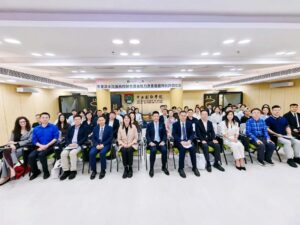
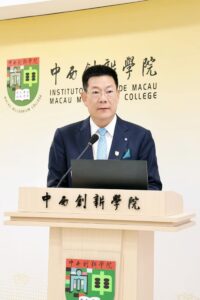
In his opening remarks, Professor Zhong Weihe noted that, with the rapid development of digital-intelligent technologies, language education is moving beyond the traditional cultivation of listening, speaking, reading, writing and translation skills, and is evolving towards a more comprehensive form of competence development that integrates cross-cultural understanding, digital literacy, the application of intelligent tools and global competence. He emphasised that higher education institutions need to systematically reshape their educational philosophies, curricula, competence standards and assessment approaches, in order to cultivate a new generation of professionals who possess both humanistic literacy and the ability to apply intelligent technologies, who understand China and are able to communicate effectively with the world. Professor Zhong further stated that MMC will continue to promote the deep integration of language education, language services and digital-intelligent technologies. Drawing on platforms such as its master’s and doctoral programmes in Digital-Intelligent Language Services, the Macao International Language Service Society, the international academic journal Journal of International Language Services, and the Greater Bay Area TESOL Professional Committee, the College will further deepen collaboration among higher education institutions in the Greater Bay Area, serve Macao’s appropriately diversified economic development, and support the cultivation of international talent in the region. He expressed the hope that the training programme would serve as an opportunity to further strengthen exchange and cooperation among universities in the Greater Bay Area, jointly promote language competence development, literacy enhancement and the development of scientific assessment systems, and contribute to the high-quality development of education in the Greater Bay Area.
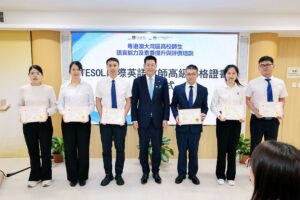
During the event, Professor Zhong presented certificates to the representatives of trainees from Guangdong Songshan Polytechnic who had completed the Advanced TESOL Certificate training. Xu Yaohong, a member of the Party Committee and Vice President of Guangdong Songshan Polytechnic, was invited to share insights into the adjustment and reform of foreign language programmes in vocational colleges in the AI era. Taking Guangdong Songshan Polytechnic as an example, he introduced the institution’s relevant explorations and practical experience.
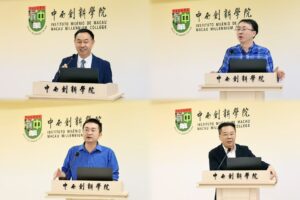
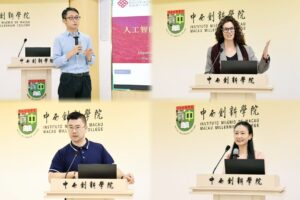
During the keynote session, a number of experts and scholars delivered presentations on frontier issues in language education, AI and digital-intelligent assessment. Professor Ren Wei spoke on “Developing Pragmatic Competence in Second Language Acquisition”, exploring the cultivation of pragmatic competence in second language acquisition. Professor Li Heng presented on “The Embodied-Cognitive Turn in Language Literacy in the Digital-Intelligent Era: From Behavioural Observation to Multimodal Intelligent Assessment”, sharing a new paradigm for language literacy assessment. Professor Wang Lifei delivered a presentation on “Explorations in Digital-Intelligent Language Service Education in Macao”, introducing innovative practices in language service education in Macao. Associate Professor Gao Yang spoke on “Digital Intelligence as the Measure, Ecosystem as the Mirror: An Eight-Dimensional Framework for Generative AI-Empowered Language Education and Precision Assessment of Teachers’ AI Literacy”, offering an in-depth discussion of the development of assessment systems for teachers’ AI literacy in the context of generative AI. Assistant Professor Malila Prado examined the relationship between language competence and real-world language use from the perspective of situated language ability. Professor Feng Dezheng gave an in-depth discussion on “The Role of Linguistic Theory in the Age of AI”.
Participating experts unanimously agreed that, amid the rapid development of AI, language education is accelerating its transformation from traditional knowledge transmission towards digital-intelligent integration, competence-oriented development and multimodal intelligent assessment. Effectively enhancing the language competence and overall literacy of teachers and students, improving scientific assessment systems, and promoting the deep integration of AI with education and teaching have become important priorities for higher education reform and innovation. Looking ahead, universities should further strengthen interdisciplinary collaboration and the application of digital-intelligent technologies, in order to cultivate high-calibre talent with a global outlook, cross-cultural communication competence and digital-intelligent literacy.
The training programme not only provided a high-level platform for exchange and cooperation among university teachers, students, experts and scholars in the Greater Bay Area, but also further demonstrated MMC’s commitment to serving the national education digitalisation strategy and promoting innovation in language education. Going forward, MMC will continue to deepen cooperation with universities, research institutions and relevant organisations in the Greater Bay Area, actively promote the deep integration of AI, multimodal technologies and language education, and continue to explore new models for language competence enhancement and the development of scientific assessment systems. These efforts will inject new momentum into the coordinated development of higher education and the cultivation of international talent in the Greater Bay Area.
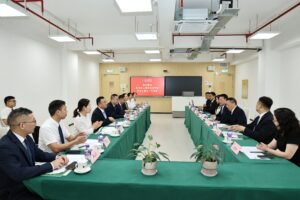
On the same morning, MMC and Guangdong Songshan Polytechnic held a discussion session on topics including the TESOL Teacher Training Programme, reform of foreign language education in vocational colleges, cross-border e-commerce programme development, and the enhancement of teachers’ digital-intelligent literacy. Both sides expressed their commitment to exploring more practical areas of cooperation and jointly supporting language education and teachers’ professional development in the Greater Bay Area.