


Education and Youth Development Bureau Visits MMC to Exchange Views on Cooperation in Teacher Training
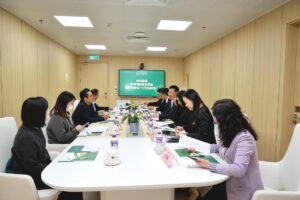
On 6 March, Mr. Tang Wai Keong, Head of the Department of Educational Resources of the Education and Youth Development Bureau (“DSEDJ”), led a delegation on a visit to Macau Millennium College (“MMC” or the “College”), where the two sides held in-depth discussions on such topics as teacher training and funding support for the professional development of teaching and research staff. The meeting was chaired by Professor Zhong Weihe, Rector of MMC.
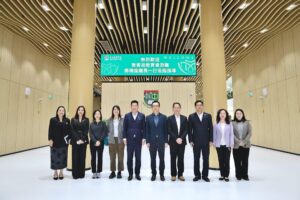
Professor Zhong first extended a warm welcome to Mr. Tang and his delegation, and shared MMC’s educational philosophy and development vision. He reviewed the College’s progress in systematically building its teaching framework in recent years, and stressed that MMC has consistently been guided by its commitment to “building a university distinguished by quality and character, and enriched by humanistic care and wellbeing”, with a view to nurturing outstanding talent equipped with both an international outlook and innovation capabilities.
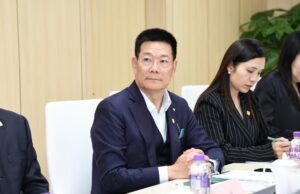
He noted that higher education institutions in Macao can consolidate the foundations of international development and create a hub for high-calibre talent by deepening international exchanges among staff and students, developing postgraduate education, and expanding study tours and academic visits, thereby achieving sustainable development. He added that, in support of the development of teachers in basic education, MMC has already established a support system built around “One Platform, One Plan and One System”: namely, an education exchange platform for the Guangdong-Hong Kong-Macao Greater Bay Area, the “Teaching Delivery to Schools” plan, and a systematic teacher training system, all aimed at continuously empowering the professional growth of local teachers in Macao. He emphasised that MMC will remain committed to serving Macao’s social development through concrete action and to working hand in hand with colleagues across the education sector.
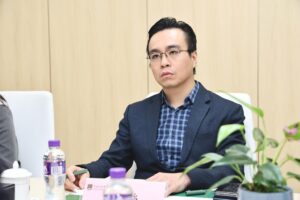
Mr. Tang first expressed his appreciation for MMC’s high-quality development and pragmatic approach. He introduced DSEDJ’s functions in relation to education funding policy, planning and the provision of information technology resources, as well as support for the professional development of teaching and research staff. He noted that the Macao SAR Government has always attached great importance to investment in education and has in particular encouraged teaching and research staff at higher education institutions to further enhance their professional capacity and international outlook. He also made specific reference to cybersecurity and data protection, reminding higher education institutions of the need to strengthen awareness of prevention and to improve their capacity to respond to risk in a comprehensive manner.
He pointed out that based on the development trend of the digital and intelligent era, DSEDJ has clarified the overall development thinking and policy orientation of artificial intelligence (“AI”) education teacher training. By launching a teacher training system centred around six areas – assistance in teaching, learning, research, education, management, and assessment, together with twenty-four AI application scenarios in education, as well as the provision of resources such as a pool of AI mentors, DSEDJ is guiding and supporting the empowering role of AI in education, so that teachers and students can better adapt to the needs of future social development. He expressed the hope that, going forward, DSEDJ and higher education institutions would deepen cooperation and jointly explore teacher training in such areas as AI education and English language teaching, so as to help take education in Macao to a new level and cultivate more outstanding talent for society.

At the meeting, Assistant Rector Huang Hua also gave a detailed presentation on two key areas of work: proposals concerning funding support for the professional development of teaching and research staff, and training for teachers in basic education. Participants also included Lai Hei, Head of DSEDJ’s Division of Teaching and Research Staff Development; Lam Man Ieng, a senior teacher of secondary education; Sit Weng Tou, a senior technical officer consultant at the Division of Resources and Welfare; Wei Qiu, Director of the Rector’s Office at MMC; Wang Xin, Director of the Centre for Continuing Education and Executive Director of the Department of Business; Yang Yanchao, Deputy Director of the Institute of International Language Services Studies; and Dong Xumei, Director of the Academic and Graduate Affairs Office.