


Macau Millennium College Hosts Greater Bay Area University Forum on Industry-Education Integration
On 18 April 2026, the “Greater Bay Area University Forum on Industry-Education Integration”, supported by the Education Fund of the Macao SAR Government and hosted by Macau Millennium College (MMC), opened at the college’s Taipa campus. The forum, themed “Integrating Industry and Education, Conversing the Future”, brought together experts and scholars from multiple higher education institutions as well as distinguished guests from the business sector. Participants engaged in in-depth discussions on topics such as profound industry-education integration, innovation in digital-intelligent language services, and the cultivation of bilingual Chinese-Portuguese talent, jointly exploring new pathways for educational innovation and industry collaboration in language services in the era of artificial intelligence (AI).
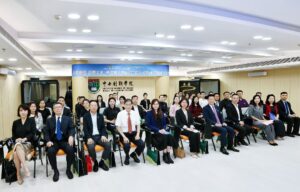
Cen Jiayi, Director of the Higher Education Division of the Education and Youth Work Department of the Liaison Office of the Central People’s Government in the Macao S.A.R., Tam Sio Wah, Acting Director of the Department of Higher Education of the Macao Education and Youth Development Bureau (DSEDJ), Xu Zhenhua, former Party Secretary and President of Guangdong University of Foreign Studies, Zhong Weihe, Rector of MMC, Chen Biaoxin, Deputy Party Secretary and Vice President of Guangdong University of Science and Technology, Wang Lifei, Vice Rector of MMC, Tang Bingyong from Donghua University, Liu Hongyan from Beijing Foreign Studies University, Zhao Yihui, Deputy Dean of School of Translation Studies of Xi’an International Studies University, Zhao Ran, Director of Commercial Translation Solutions at iFLYTEK, Huang Hua, Assistant Rector of MMC, as well as representatives from multiple language technology enterprises, participated in the forum.
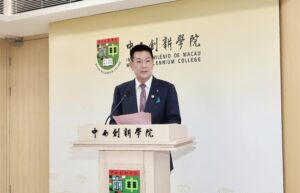
In his opening remarks, Zhong Weihe stated that new-generation general-purpose technologies such as AI are profoundly reshaping educational models, industrial logic, and the way society operates, and that the integration of industry and education has become the inevitable path for higher education to serve the country’s overall development, improve the quality of education, and orient itself toward future development. In the age of AI, language services have become a crucial link connecting knowledge production, technological transformation, industrial collaboration, and international communication. In recent years, MMC has continuously advanced industry-education integration and innovative development. It takes the lead in establishing the world’s first master’s and doctoral programmes in “Digital-Intelligent Language Services”, while actively promoting the establishment of the Macao International Language Service Society. Zhong Weihe emphasised that high-quality industry-education integration relies on a stable, long-lasting collaborative framework that turns industry demands into educational objectives, cutting-edge technology into classroom teaching, and research results into tangible impact. He expressed hope that the forum would serve as a springboard to strengthen cooperation among universities, enterprises, and government-industry-academia-research partners in the Guangdong-Hong Kong-Macao Greater Bay Area, so as to jointly explore more dynamic and effective approaches to industry-education integration.
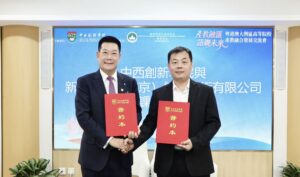
At the opening ceremony, MMC, Macau University of Science and Technology Innovation Technology Research Institute in Hengqin Guangdong-Macao In-Depth Cooperation Zone, and New Tranx Information Technology (Beijing) Co., Ltd. held a signing ceremony for collaborative research projects. The three parties agreed to collaborate on the application of AI and multilingual intelligent technologies, and launched three forward-looking and practical projects, i.e., demonstration of a Chinese-English-Portuguese emergency speech translation system in the Greater Bay Area, powered by edge-based large models, development and applied research of a multilingual, multimodal intelligent companion wristband for Macao’s elderly population, and development of a Chinese-English-Portuguese multilingual automatic essay evaluation and intelligent revision system based on large language models. This collaboration will further advance the practical implementation of AI in language services, public services, and education, promote the in-depth integration of industry, academia, research, and application, and inject new momentum into the cultivation of language technology talent and industrial development in the Greater Bay Area.
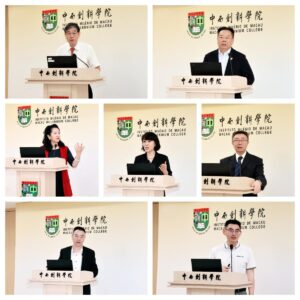
During the keynote report session, several experts, scholars, and industry representatives shared in-depth insights on cutting-edge topics in language services and industry-education integration. Xu Zhenhua, building on the backdrop of AI reshaping higher education, focused on innovations in cultivating bilingual Chinese-Portuguese talent integrated with AI. He advocated for reshaping teaching content by building a “bilingual + AI” disciplinary framework and an embedded curriculum system, with the aim of cultivating cross-cultural talent equipped with high-quality bilingual application skills, digital-intelligent technologies, and critical thinking, thereby exploring new pathways for talent cultivation that uphold the humanistic values and intellectual dignity amid the wave of AI. Using the construction of the graduate degree program in Digital-Intelligent Language Services at MMC as an example, Wang Lifei shared his experience in curriculum system design and collaborative practice among industry, education, and research for digital-intelligent language services in the context of new quality productive forces. This program innovatively establishes a three-way integrated training model of “language + technology + industry”, dedicated to cultivating high-end digital-intelligent language service professionals who master AI technologies while possessing cross-disciplinary integration capabilities. Liu Hongyan, drawing on multimodal corpus technology, discussed research on translating language health services for older adults with cognitive impairments from the laboratory to nursing homes, highlighting the social value of technological outcomes. Zhao Yihui, in a presentation titled “Integrating Industry and Education, Connecting Languages for the Future”, analysed pathways for the collaborative development of cross-regional language service talent in the era of intelligent technology. Tang Bingyong, in light of the needs of cross-border e-commerce, proposed a new industry-education integration model featuring the deep integration of digital-intelligent language services with industry. Chen Biaoxin emphasised the critical role of industry-education integration platforms in advancing national development priorities. Zhao Ran demonstrated how AI can reconstruct cross-language communication scenarios in higher education institutions, empowering the digital transformation of international education. The experts’ insights highlighted emerging trends in blending language education with technology and aligning talent development with industry needs, offering fresh, multidimensional perspectives to drive innovation in the sector.
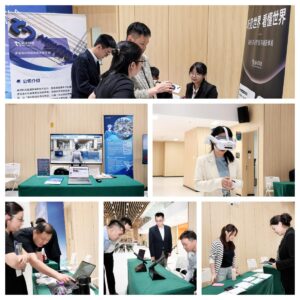
During the corporate showcase segment, multiple companies highlighted cutting-edge achievements in AI translation, multilingual language services, medical information technology, cross-language communication support, and intelligent application devices, providing attendees with a deeper understanding of trends and practical applications in the language technology industry. Beijing Yaxincheng Medical InfoTech Co., Ltd. focuses on the medical language services sector, showcasing benchmark cases in specialised medical translation, multilingual solutions, and academic-industry services. Through an immersive showcase of “hardcore products + benchmark cases”, Yaxincheng deeply connected university experts with industry partners, successfully building an efficient bridge linking industry, academia, research, and application, and fully demonstrating its leading strength in specialised and refined language services. Beijing CASWISE Technology Co., Ltd.’s cutting-edge technology products attracted widespread attention. Experts and educators from around the country stopped to try out the products, and highly praised their innovative features and outstanding performance, creating a lively and engaging atmosphere on-site. New Tranx made a major debut with its full-stack “Xiangxu Large Model + Smart Terminal” technology suite, showcasing on-site its self-developed Xiangxu Large Model, intelligent translation engine, and core hardware products such as dual-screen devices, translation headsets, and portable translators, comprehensively covering critical scenarios including multilingual communication and industry-education training. Shenzhen Saiaining Technology & Culture Co., Ltd., in collaboration with the National Key Laboratory of Virtual Reality Technology and Systems, showcased the “Follow Along” series—an AI + XR VR large-space experience project—which became a standout highlight of the industry-education integration achievements at the forum. Its core product, “Follow Along · the Long March”, uses AI and XR to vividly recreate the course of the Long March, setting a new benchmark for immersive national education in commemoration of the 90th anniversary of the Long March victory. At the same time, Chengdu VIVEDM Technology Co., Ltd., an educational technology enterprise serving more than 600 colleges and universities nationwide, spotlighted two flagship products: the XRAI Language Training Platform and the Metaverse MOOC System. The XRAI platform integrates virtual reality (VR) and AI technologies to create immersive language learning scenarios; the Metaverse MOOC System, through 3D virtual classrooms and intelligent interactive functions, promotes the digital transformation of language teaching in higher education. In the future, MMC will join hands with language service enterprises in the Greater Bay Area to jointly build a digital-intelligent language service talent cultivation system, promote the integration of industry and education, and inject new momentum into educational innovation.
The forum not only provided a high-level platform for exchange and cooperation among universities, research institutions, and enterprises in the Greater Bay Area, but also further demonstrated the commitment and responsibility of MMC to actively serve national strategies, address Macao’s development needs, and drive industry-education integration and collaborative innovation. Looking ahead, MMC will continue to deepen collaboration with universities, research institutions, and enterprises in the Greater Bay Area, actively promote the seamless integration of AI, multilingual technologies, and education and teaching. It will keep exploring new models for training talent in digital-intelligent language services, aiming to establish Macao as a hub for Chinese-Portuguese bilingual talent and contribute further to the high-quality development of the Greater Bay Area.