


Professor Zhong Weihe, Rector of Macau Millennium College, Attends the 15th China Hotel Culture Festival and the 2026 Guangdong-Macao Hotel Industry Cooperation and Development Conference
On 22 April 2026, the 15th China Hotel Culture Festival and the 2026 Guangdong-Macao Hotel Industry Cooperation and Development Conference opened in Hengqin. Themed “The 15th Five-Year Plan: New Consumption, New Integration, and New Growth”, this year’s festival focused on the high-quality development of the accommodation and catering sector, the digital-intelligent transformation of the hotel industry, brand building, green development, industry-education integration, and industrial collaboration between Guangdong and Macao. The event brought together representatives from the hotel industry, experts, scholars and business leaders from the Chinese Mainland, the Hong Kong SAR and the Macao SAR to explore new pathways for innovation and development in the accommodation and catering sector in the new era.
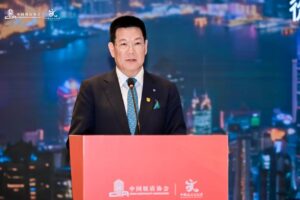
Professor Zhong Weihe, Rector of Macau Millennium College (“MMC” or the “College”), was invited to attend the event. At the inaugural Guangdong-Macao Hotel Industry Cooperation and Development Forum held on 24 April, he delivered a keynote speech entitled “An Analysis of the Spatial Pattern and Development Opportunities of the Hotel Industry in the Guangdong-Hong Kong-Macao Greater Bay Area”, sharing his research findings and industry insights.
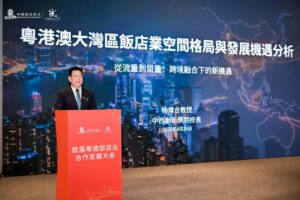
Professor Zhong noted that, as cross-border integration in the Guangdong-Hong Kong-Macao Greater Bay Area continues to deepen, cross-border mobility is shifting from “passing through” to “staying”, while consumer behaviour is moving from “quick visits” to “experience-led consumption”. The hotel industry is evolving from a traditional supporting service for accommodation into an important spatial platform for receiving cross-border visitors, stimulating urban consumption and enriching cultural and tourism experiences. In the future, the core of competition in the hotel industry will no longer lie solely in conventional transport location advantages, but in whether hotels can convert visitor flows into overnight stays, short-term transit into sustained consumption, and traffic nodes into consumer destinations.
Professor Zhong explained that his research team had integrated more than 2.23 million pieces of high-precision POI data and various types of geospatial information, covering the “9+2” cities of the Guangdong-Hong Kong-Macao Greater Bay Area. Based on four dimensions—accessibility, source-market base, functional mix and landscape environment—the team developed an assessment framework for evaluating location suitability in the hotel industry. The research shows that Macao, Shenzhen, and Hong Kong constitute the first tier of hotel industry suitability in the Greater Bay Area. Macao, in particular, displays a distinctive pattern of “small area, high intensity”, with limited urban space supporting highly concentrated consumption, accommodation, cultural and tourism functions. At a more detailed district and county level, core areas such as the Macao Peninsula, Kowloon in Hong Kong, Yuexiu in Guangzhou and Futian in Shenzhen stand out. This suggests that high-potential hotel industry spaces do not spread evenly with overall city capacity, but are more concentrated in core areas capable of converting visitor flows into stays and transit into consumption.
He further pointed out that the Guangdong-Hong Kong and Guangdong-Macao cross-border consumption corridors follow different spatial logics. The Guangdong-Hong Kong corridor extends along the Shenzhen-Hong Kong boundary and resembles a cross-border metropolitan consumption belt formed by multiple connected nodes. It is well-suited to the development of transit business hotels, cross-border hotel chains and mid- to high-end business travel accommodation. By contrast, the Guangdong-Macao corridor is highly concentrated from the northern end of the Macao Peninsula to Hengqin, resembling a high-density, high-conversion cross-border consumption cluster. It is therefore suited to the development of resort complexes, high-end hotel clusters and leisure holiday products.
The research also divided the areas around major cross-border checkpoints into four levels of catchment zones—3 km, 8 km, 15 km and 30 km—and identified Shenzhen Bay, Qingmao, Gongbei and Luohu as the four core checkpoints for cross-border consumption in the Greater Bay Area. Among them, Shenzhen Bay delivered the strongest overall performance; Qingmao and Gongbei demonstrated the capacity of Macao’s northern gateways to support high-intensity cross-border consumption; and Luohu reflected the continued resilience of traditional checkpoints in both business and consumption.
Professor Zhong argued that the key to future competition in the Greater Bay Area’s hotel industry lies in whether short-stay transit flows can be converted into overnight demand, multi-layered consumption and deeper experiences. He suggested that the industry should adopt a tiered layout strategy according to different catchment zones and scenarios. Within the 3 km core zone around checkpoints, priority should be given to efficient transit accommodation, cross-border business reception and products designed to capture high-frequency consumption. Within the 3–8 km close-in zone, the focus should be on composite hotel formats that combine urban living, business functions and leisure consumption. Within the 8–15 km catchment zone, products should be developed around industrial corridors, conventions and exhibitions, waterfront spaces, and cultural and tourism resources, with an emphasis on both extended business stays and leisure experiences. Within the 15–30 km influence zone, boutique guesthouses, resort hotels and in-depth experience-based projects can be cultivated by drawing on demand for eco-tourism, seaside leisure, wellness, study tours and weekend getaways.
In the future, MMC will continue to be rooted in Macao while serving the Greater Bay Area. Focusing on key areas such as smart tourism, the digital economy, language services, cultural communication and industrial innovation, the College will strengthen interdisciplinary research and collaboration among government, industry, academia and research institutions. In doing so, it will contribute further intellectual support to Macao’s appropriately diversified economic development and the high-quality development of the Guangdong-Hong Kong-Macao Greater Bay Area.