


2026 Macao International Digital Intelligence Education Conference and the 3rd GBA Forum on Primary and Secondary Education Innovation in the Digital Intelligence Era Successfully Held in Macao
On 13 June 2026, the 2026 Macao International Digital Intelligence Education Conference and the 3rd GBA Forum on Primary and Secondary Education Innovation in the Digital Intelligence Era were successfully held in Macao. Supported by the Education and Youth Development Bureau of Macao (the “DSEDJ”), the event was hosted by Macau Millennium College (“MMC” or the “College”) and the Macao Bay Area Digital Economy Association, organised by MGM, and supported by co-organisers including the Macao Association for Higher Education Development and The Chinese Educators Association of Macau. It attracted more than 300 representatives from the education, academic, and technology sectors across the Guangdong-Hong Kong-Macao Greater Bay Area (the “Greater Bay Area”), as well as from the Chinese mainland and overseas.
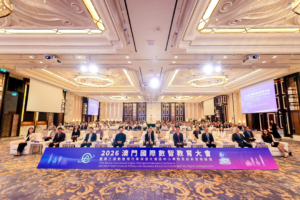
The opening ceremony was held at MGM COTAI. In his remarks, Professor Zhong Weihe, Rector of MMC and Chair of the Supervisory Board of the Macao Association for Higher Education Development, said that the event, with the Macao International Digital Intelligence Education Conference as its main platform and the 3rd GBA Forum on Primary and Secondary Education Innovation in the Digital Intelligence Era held concurrently, reflected an open vision oriented towards the world and the future. It also built on the strong foundation laid by the Greater Bay Area’s basic education community in jointly exploring smart education and advancing educational innovation. He noted that, in the digital and intelligent era, MMC is actively developing a talent cultivation system centred on “Digital and Intelligent +”. Focusing on areas such as digital technology, digital and intelligent language services, smart tourism and entertainment management, cross-border e-commerce, and digital and intelligent teacher education, the College is exploring new pathways that align higher education with industry needs, regional development, and international cooperation. The College hopes to work with fellow educators from all sectors to build platforms for exchange and cooperation, deepen educational collaboration in the Greater Bay Area, promote the deeper integration of digital and intelligent technologies with education and teaching, and contribute to cultivating outstanding talent who can meet future needs, serve society, and connect with the world.
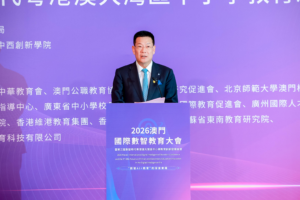
Leong I On, Head of the Division of Secondary Education of the DSEDJ, stated in his speech that the global technological revolution and industrial transformation are accelerating, and that AI is bringing new challenges and opportunities to educational models, teaching methods, and talent cultivation. He also noted that the DSEDJ will continue to support educational innovation in Macao through systems, resources, faculty, and the educational ecosystem. This includes deepening curriculum reform, promoting the development of AI educational resources, and strengthening teacher training. These efforts will align with Macao’s “1+4” strategy for appropriate economic diversification and the development of the Guangdong-Macao In-Depth Cooperation Zone in Hengqin to expand cross-regional educational cooperation. He also called on fellow educators to face the changes brought by digital and intelligent education with courage, actively embrace technological innovation, remain committed to the fundamental mission of education, and work together to cultivate more outstanding talent for the country and for Macao.
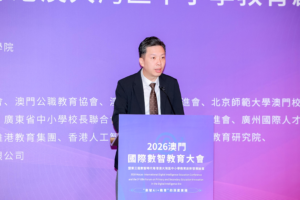
Cheang Hong Kuong, Chairperson of The Chinese Educators’ Association of Macau, stated that the hosting of the 3rd GBA Forum on Primary and Secondary Education Innovation in the Digital Intelligence Era reflects the hosts’ forward-looking grasp of trends in digital and intelligent education and provides a platform for continuous exchange and cooperation for the primary and secondary education sectors in the Greater Bay Area. He noted that, in the digital and intelligent era, the question of how primary and secondary education should respond to technological changes such as AI, big data, and cloud computing is an important one that contemporary educators must answer. In recent years, applications such as smart classrooms, precision assessment, and personalised learning recommendations have gradually been integrated into educational practice. Digital and intelligent education brings both challenges and opportunities. Looking to the future, he emphasised that education should remain people-centred, ensuring that digital technologies serve the all-round development of learners, while recognising the irreplaceable role of teachers in the education process. At the same time, educational collaboration in the Greater Bay Area should be strengthened, the joint development and sharing of educational resources should be promoted, and Macao’s strengths in Chinese-Portuguese bilingualism and international networks should be leveraged to build an educational bridge connecting Portuguese-speaking countries and countries participating in the Belt and Road Initiative.
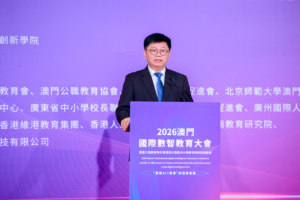
He Yong, Chairman of Guangzhou Zhixin Education Group, Vice President of the Guangdong Primary and Secondary School Principals’ Association, and former Party Secretary and Principal of Guangzhou Zhixin High School, stated that this forum echoes the core themes of the 2026 World Digital Education Conference regarding AI-driven systemic transformation and governance in education. He noted that the forum provides a high-level exchange platform for educators in the Greater Bay Area and is both timely and profoundly significant. He also pointed out that the development of digital education and the empowerment of school and education innovation through AI represent key directions for the reform and development of schools in the future. Drawing on his own school’s practices, he shared explorations of AI applications in lesson preparation, classroom teaching, test design, homework marking, teaching analysis, and learner profiling. He also suggested that greater attention should be paid in the future to how AI can empower students’ active learning and enhance their capacity for independent learning, critical thinking, and discernment. He observed that AI-empowered education still faces challenges such as insufficient top-level design, fragmented application scenarios, and dispersed school-level exploration. He expressed the hope that the forum and practical workshops would promote mutual learning and collaborative innovation among schools in the Greater Bay Area, turning individual examples of innovation into a broader landscape of shared practice. He called on the education sector to uphold the principle of “technology as a tool and education as the foundation”, preserve the enduring mission of education amid digital change, jointly create a new landscape for education through integration across the Greater Bay Area, and promote the high-quality development of basic education in the region.
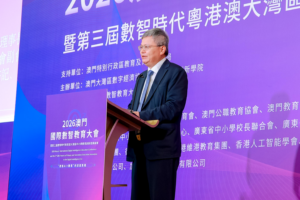
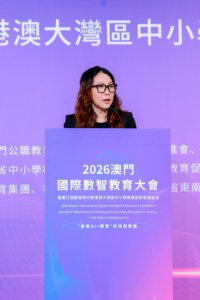
Lei Lai Fong Patinda, President of the Macao Bay Area Digital Economy Association, said that the conference brought together experts, scholars, educators, and industry representatives from more than 20 countries and regions, including the Chinese mainland, Hong Kong, Macao and Taiwan regions, Portugal, Russia, and France. This fully demonstrated Macao’s unique role as a platform where Chinese and Western cultures meet and as a window for international exchange. She expressed her gratitude to the DSEDJ, MGM, MMC, and all co-organisers and supporting units for their support. She noted that Macao is taking on a new mission to connect China with the world and promote exchange and cooperation in digital and intelligent education. She stated that the Strategic Cooperation Platform for International Talent and Global Governance Practice in the Greater Bay Area under the United Nations’ Sustainable Development Framework, launched during the conference, would help cultivate young talent with a global governance perspective and promote deeper connections between education in the Greater Bay Area and international resources. She expressed the hope that the conference would serve as an opportunity to leverage Macao’s platform advantages, promote cross-regional and cross-border educational cooperation, bring together insights from all parties, and jointly explore the future direction of educational innovation in the digital and intelligent era.
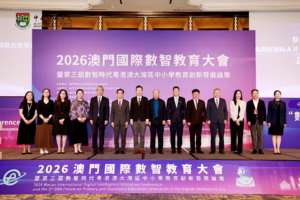
At the opening ceremony, a ribbon-cutting ceremony was held for the Strategic Cooperation Platform for International Talent and Global Governance Practice in the Greater Bay Area under the United Nations’ Sustainable Development Framework. The launch of the platform marks a new step forward for the Greater Bay Area in international talent development, educational practice in global governance, and cooperation in education for sustainable development. It will further promote deeper connections between schools and higher education institutions in the Greater Bay Area and international organisations, educational institutions, and industry platforms, while creating regular, institutionalised channels for cross-border talent development.
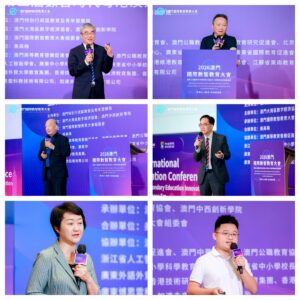
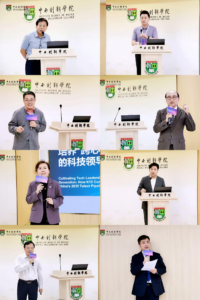
During the keynote speech session, a number of experts, scholars, and education representatives delivered thematic presentations on global governance, AI, teacher development, and innovation in basic education. Wu Yugang, Director of CIFAL Shanghai of the United Nations Institute for Training and Research (“UNITAR”), delivered a speech titled “United Nations Perspective: Global Governance and International Talent Cultivation“, interpreting the core competencies and cultivation directions required for global governance talent from an international organisation’s perspective; Professor Jin Xiaogang from the College of Computer Science and Technology of Zhejiang University spoke on “The Wave of Artificial Intelligence: The Future of Education“, analysing the profound changes AI brings to teaching models, classroom formats, and educational evaluation systems; Wu Yingmin, a renowned Chinese educator and Honorary Principal of Guangzhou Middle School, presented “Teacher Ethics and Competence in the Digital and Intelligent Era“, emphasising that teacher development in this era is not only about strengthening teachers’ digital capabilities but also about staying true to the original mission of educating and nurturing students; Kou Kam Fai, Principal of Pui Ching Middle School Macau, shared practical experiences in integrating AI into Macao’s basic education and smart campus development in his speech “AI Empowering Basic Education — Practice and Exploration of Pui Ching Middle School Macau’s Educational Philosophy“; Dr Aglaia Kong, Vice President of the Macao Bay Area Digital Economy Association, spoke on “Artificial Intelligence: A Blessing or a Challenge for Humanity?“, analysing the opportunities and risks brought by AI from the perspectives of technological development and educational application, and advocating the rational, standardised, and responsible use of AI in education. Li Wei, Head of General Education at All Win Win Technology Industry Development (International) Co., Ltd., shared a presentation titled “OpenHarmony + AI: Creating a New Paradigm for General Education and Industry-Education Integration in Primary and Secondary Schools in the All-Scenario AI-Native Era“, exploring practical paths for OpenHarmony and AI to empower innovation in general education at primary and secondary schools from the perspectives of technology application, curriculum development, and industry-education integration.
In the afternoon, two sub-venues were set up at MGM COTAI and the Taipa Campus of MMC. At the MGM COTAI sub-venue, three parallel thematic forums were held, focusing respectively on innovation in subject teaching, immersive teaching scenarios, and international education cooperation in the Greater Bay Area. Together, they facilitated two-way alignment between high-level strategy and frontline teaching practice. The first sub-forum focused on AI-enabled personalised learning and the development of smart subject laboratories. Participating principals and teaching researchers discussed human-AI collaborative teaching models, clarifying that AI should be positioned as a teaching support tool, that teachers should remain central to the education process, and that a new classroom ecosystem should be built in which teachers, students, and intelligent devices coexist and collaborate. The second sub-forum focused on hot topics such as AI-powered immersive teaching applications, the cultivation of teachers’ and students’ digital literacy, and AI-supported mental health education. Experts from a number of universities in the Chinese mainland shared empirical research findings and explored new models of digital and intelligent education supported by collaboration among families, schools, and communities. The third featured sub-forum, grounded in the Greater Bay Area’s international orientation, provided an open platform for discussion on cross-border sharing of educational resources and the building of talent ecosystems, exploring replicable pathways for international education cooperation in the Greater Bay Area.
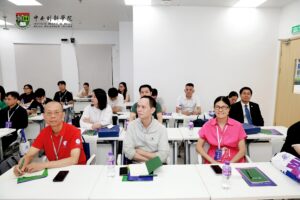
At the Taipa Campus sub-venue of MMC, three events were held in parallel: The Principals’ Forum, the AI Practice Workshop, and the Further Studies Forum. The Principals’ Forum featured in-depth exchanges on topics including future forms of education, AI-empowered school governance, cross-border education practice, and the coordinated development of basic education in the Greater Bay Area. The keynote speech session was moderated by Associate Professor Yang Yanchao, Director of the Department of Digital and Intelligent Language Services of MMC.
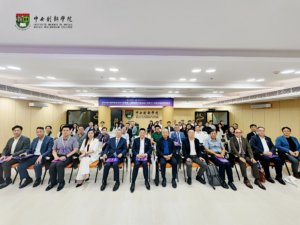
Speakers included Professor Wu Zhongkui, former Vice President of Beijing Normal University, Zhuhai; Liu Xiongfei, President of Yinchuan University of Science and Technology and Dean of the Green Energy and Digital and Intelligent Modern Industry College of the Autonomous Region; Professor Hong Chengwen of MMC; Lawrence Tsui, Principal of Millennium Secondary School; Chan Sio Ieong, Vice Principal of Kao Yip Middle School; Su Yuan, Executive Principal of the Tianhe Longdong and Haizhu Poly campuses of Affiliated School of JNU for Hong Kong and Macao Students – Guangzhou; and Xu Jun, Founding Principal of Capital Normal University High School Hengqin. Drawing on their respective school-running practices, they shared experience and reflections on school development, talent cultivation, and educational innovation in the digital and intelligent era.
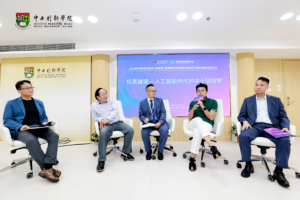
The roundtable forum was moderated by Frank Yuan, initiator of the AI Campus Project and founder of AFE Co. Limited. Panellists included Lei Chao Lam, Principal of Pui Va Middle School of Macau; Chen Wenguo, Founding Principal of Shanghai Hongrun Boyuan School; Zhang Guiyuan, Executive Principal of Affiliated School of JNU for Hong Kong and Macao Students – Foshan; and Huang Xiang, General Principal of Ardingly College Zhongshan. They engaged in dialogues concerning school transformation in the AI era, international talent cultivation, cross-border educational cooperation, and the development of future learning environments. Their discussions provided diverse perspectives and practical references for the innovative development of basic education in the Greater Bay Area.
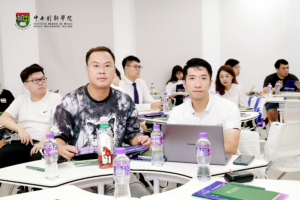
The AI Practice Workshop focused on the application of AI tools, the design of teaching scenarios, and the enhancement of hands-on capabilities, guiding participating teachers and educators to understand practical pathways for AI-empowered teaching through direct experience. The Further Studies Forum centred on students’ further-study planning, the articulation of educational resources in the Greater Bay Area, and diverse pathways for further studies, providing a reference for student development and home-school collaboration.
With Macao serving as a bridge connecting the Greater Bay Area with the wider world, the conference effectively promoted the exchange of digital and intelligent education experience and the sharing of resources between China and other countries. Moving forward, participating institutions will leverage this conference as an opportunity to deepen pragmatic cross-border and cross-sector cooperation, accelerate the implementation and application of high-quality digital and intelligent education outcomes, continue improving the Greater Bay Area’s international smart education system, and support the region in building a digital and intelligent education hub with international influence.