



Two Sustainability Studies Studies Co-authored by Macau Millennium College Faculty Published in Nature Portfolio Journals
Recently, Assistant Professor Yan Kejia from the Department of Smart Tourism at Macau Millennium College participated in the completion of two research outcomes, which were successively published in the Nature Portfolio journals Humanities and Social Sciences Communications and npj Urban Sustainability. The two studies focus respectively on the emission reduction effects of carbon trading systems in supply chains and the sustainable development paths of resource-based cities in China, providing new research perspectives and policy references for global climate governance and urban green transformation.

Humanities and Social Sciences Communications is a comprehensive journal in the humanities and social sciences under Nature Portfolio, indexed in SSCI, ranked in JCR Q1 and in Area 1 of Humanities and Social Sciences by the Chinese Academy of Sciences, with a latest impact factor of 4.8. npj Urban Sustainability is an npj-series journal under Nature Portfolio, mainly publishing research results in the fields of urban sustainability, urban governance, and climate change, indexed in SSCI, ranked in JCR Q1 and as a TOP journal in Area 1 of Environmental Science and Ecology by the Chinese Academy of Sciences, with a latest impact factor of 10.8.
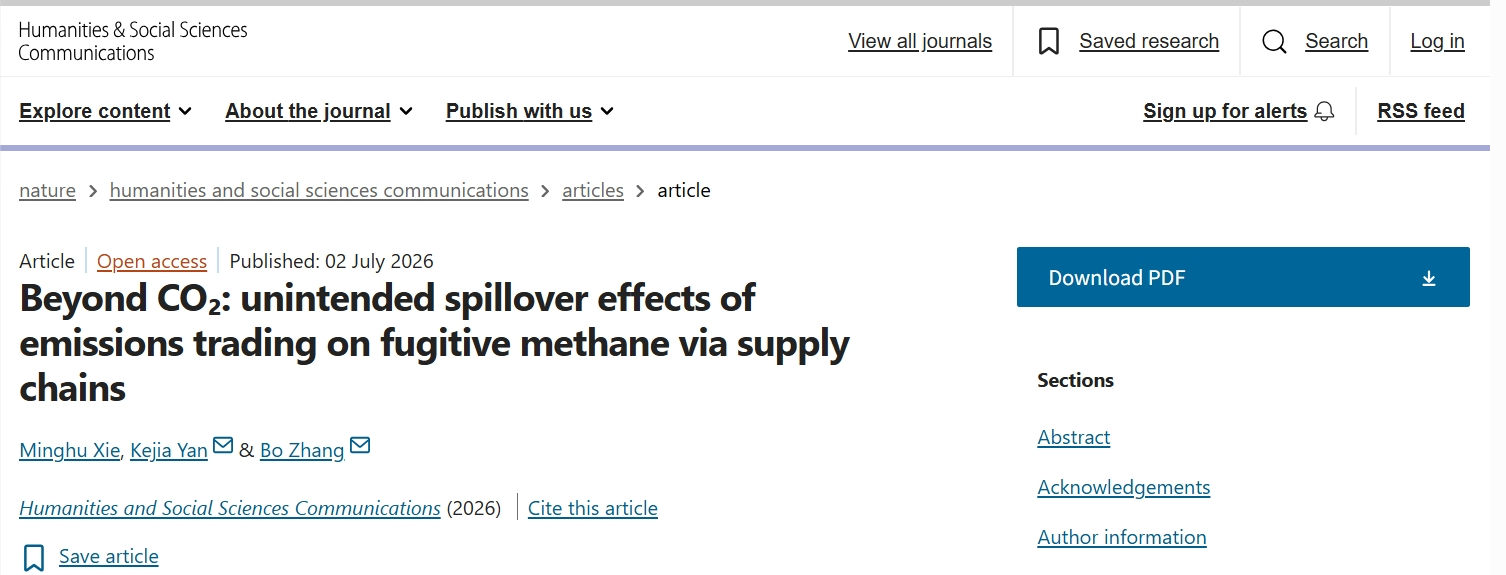
The first study is titled Beyond CO₂: Unintended Spillover Effects of Emissions Trading on Fugitive Methane via Supply Chains. The research is based on industry-level data from G20 economies from 1990 to 2023, using a staggered difference-in-differences model to systematically assess the impact of the carbon trading system on CO₂ emissions in six high-emission sectors and fugitive methane emissions in upstream supply chains.
The study found that the carbon trading system can not only reduce CO₂ emissions in downstream sectors, but also indirectly lower fugitive methane emissions in upstream supply chains by reducing fossil energy demand, reflecting that the carbon market has a certain synergistic emission reduction effect across different emission stages and industry chains. At the same time, the study points out that the current carbon trading system still primarily focuses on CO₂ emissions, and has certain limitations in managing non-CO₂ greenhouse gases such as methane.
Based on the above findings, the study proposes that in the future, the methane emission monitoring, reporting, and verification system can be further improved, policy tools targeting upstream fugitive emissions can be explored, and the carbon market can be promoted to expand from single emission control to coordinated management of multiple greenhouse gases, providing a theoretical basis and policy insights for the improvement of the global carbon market system.
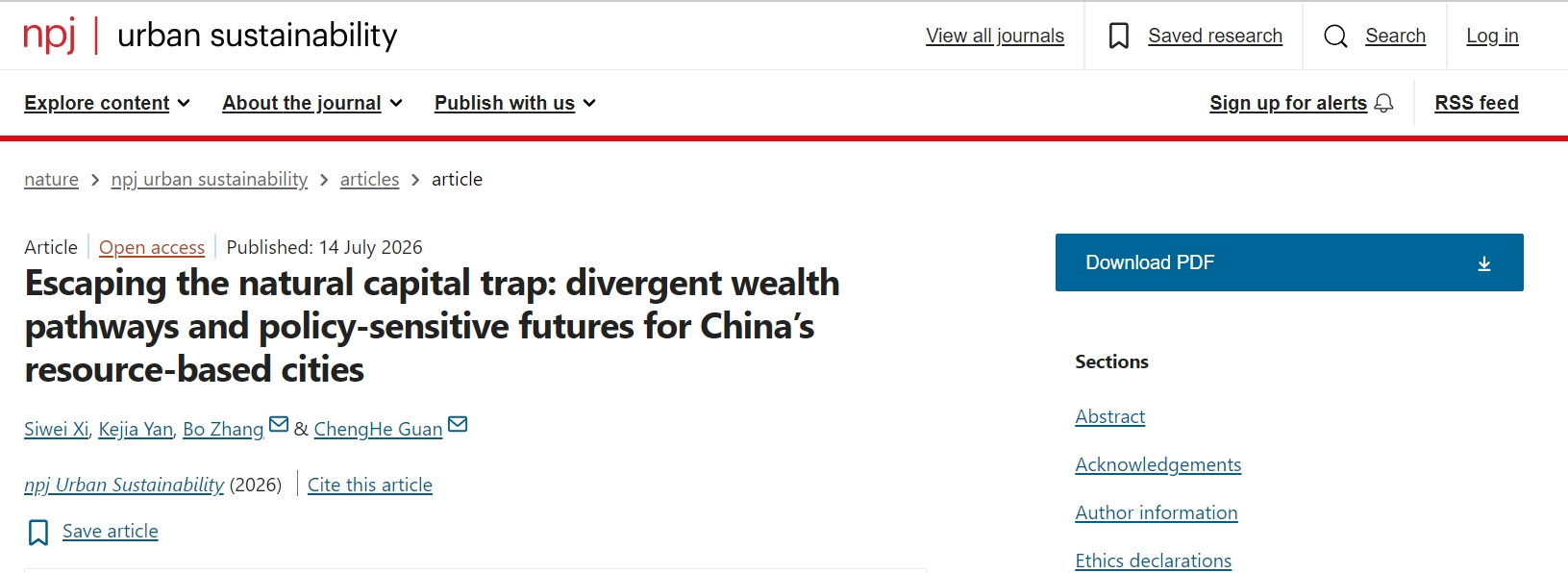
The second study is titled 'Escaping the Natural Capital Trap: Divergent Wealth Pathways and Policy-Sensitive Futures for China’s Resource-based Cities.' The study focuses on 109 resource-based cities in China, constructing an inclusive wealth index framework and combining urban life cycle theory with scenario prediction models to analyse the wealth accumulation characteristics and sustainable development pathways of different types of resource-based cities.
The results of the study show that there are significant regional and type differences in the sustainable development levels of China’s resource-based cities. Among them, regenerative cities are gradually reducing their dependence on natural capital and shifting toward produced capital and other factors as the main drivers; some declining cities, however, still face challenges such as insufficient wealth accumulation capacity and low coordination among different types of capital.
Scenario prediction results indicate that different policy combinations will have differentiated effects on the sustainable development of resource-based cities before 2030. Based on this, the study suggests that transformation and development strategies should be formulated in accordance with the life cycle stages of different types of resource-based cities, optimising the allocation of natural, human, and produced capital, enhancing cities’ capacity for sustainable wealth accumulation, and providing decision-making references for the green transformation of resource-based cities and the achievement of the United Nations Sustainable Development Goals.
In recent years, Macau Millennium College has continuously promoted interdisciplinary scientific research collaboration, conducting studies around topics such as climate governance, energy transition, urban sustainable development, and public policy. These two studies analyse the global carbon market system and the development of resource-based cities in China, respectively, expanding research areas such as supply chain collaborative emission reduction and urban sustainable wealth assessment, reflecting the college’s increasingly in-depth scientific research layout in sustainable development.
In the future, the College will continue to integrate its 'Digital and Intelligent +' development focus, promote interdisciplinary integration in fields such as energy economics, urban governance, public policy, and sustainable development, strengthen high-level research collaboration and results transformation, and actively serve the national 'dual carbon' strategy and the United Nations Sustainable Development Goals.