




Smart Bookshelf
Authors: Tan Zehan and Shen Henghua
Brief Introduction
This project focuses on the upgrade of intelligent library management by creating a smart bookshelf that integrates “AI + intelligent control + multi-level positioning”. It replaces the traditional manual management model and addresses pain points of conventional bookshelves, including safety risks, low positioning accuracy, inconvenience in retrieving and returning books from upper shelves, and low management efficiency. The smart bookshelf adopts a double-sided zoned layout and a vertically layered design. It integrates a multi-level spatial coding and positioning system with an intelligent gripping mechanism, enabling core functions such as autonomous book storage and retrieval, precise positioning, intelligent inventory checking, and safe operation and maintenance. By connecting the full process of book storage, outbound retrieval, borrowing and return, the system transforms the traditional model of “people looking for books” into one where “books come to people”. It provides a new solution for the automation and intelligent upgrading of libraries, helping to build a safe, efficient and convenient smart library management ecosystem.
Example Display Scenarios
1. Double-Sided Zoning for Safe Operation
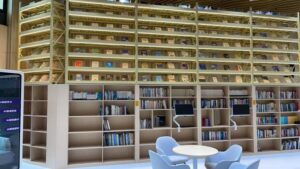
The smart bookshelf adopts an innovative double-sided design. One side serves as the robot operation area, while the other serves as the manual operation area. Physical separation enables human–robot segregation, preventing mutual interference during operation and greatly reducing safety risks such as collisions. The robot operation area is equipped with safety doors fitted with electromagnetic locks, warning signs, sensing devices and emergency stop buttons. The manual operation area features anti-slip flooring and emergency lighting. A transparent acrylic partition is installed in the middle, ensuring safe separation while allowing visual monitoring. This all-round design helps protect both personnel and equipment.
2.Display of the Core Functions and Positioning System
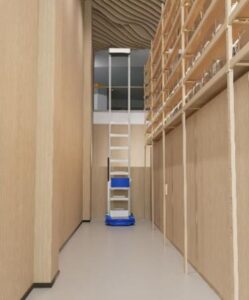
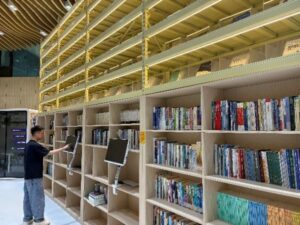
The smart bookshelf adopts a vertically layered design. The area from 0 to 2,160 mm is designated as the manual book retrieval and return area, allowing readers to operate directly. The area from 2,160 to 5,200 mm is designated as the robot book retrieval and return area, where the robot handles books on upper shelves, reducing the safety risks associated with manual high-level operations. The built-in multi-level spatial coding and positioning system precisely locates each book through a combination of ground-level Z-zone codes, shelf-level Y-layer codes and book-bin X-position codes. This positioning method is not affected by lighting conditions, book wear or similar factors. Equipped with an intelligent robot and a dual-gripper design, the bookshelf can grip book bins accurately and complete retrieval, placement and transfer operations fully automatically, without manual intervention.
3. Book Borrowing and Return Interaction Scenario
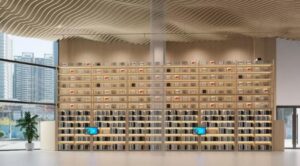
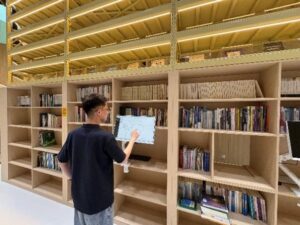
The smart bookshelf is equipped with a book pickup and return bay and a touchscreen computer. The bay is fitted with positioning QR codes and a guide rail system to ensure that the robot can deliver the book bin accurately. With a bay height of 700–1,000 mm, the design conforms to users’ operating habits. The book borrowing and return process is simple and efficient. When borrowing a book, the reader enters the required information on the terminal. The system then uses multi-level positioning to guide the robot to retrieve the corresponding book bin and deliver it to the pickup bay. When a book is returned, the robot first delivers an empty bin to the bay. After the reader places the book inside, the robot accurately returns the bin to its designated position. Each book bin has a standard size of 300 × 300 × 200 mm. A fixing base at the bottom secures the book, with each bin corresponding to one book. The design is compatible with the vast majority of book sizes.
This project is dedicated to creating a smart bookshelf that combines practicality with a sense of technology. By integrating a double-sided safety design, multi-level precise positioning and efficient human–robot interaction, it overcomes the limitations of traditional library management and significantly improves the safety, accuracy and efficiency of library management. It offers a new model for the development of future smart libraries.
4.Invention Patent
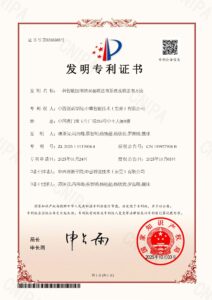
This smart bookshelf has obtained the invention patent “A Double-Sided Book Borrowing and Return System and Method for Smart Libraries“. The patent discloses a double-sided book borrowing and return system and method for smart libraries, relating to the field of artificial intelligence technology for library applications. The system includes a double-sided bookshelf unit, with one side designed as the robot operation area and the other as the manual operation area, preventing mutual interference. It also includes a multi-level spatial coding and positioning system. Through three types of positioning codes, the system can accurately locate each book. A vertical zoning and book pickup and return bay interaction unit divides the bookshelf vertically into upper and lower areas: The lower area is used for manual book retrieval and return, while the upper area is used for robot-based book retrieval and return. The system further includes a robot gripping design for book bins. The robot uses two grippers to hold fixed-size bins and identifies QR codes for positioning during book retrieval and return operations. The invention offers significant technical advantages in improving the safety, accuracy and efficiency of library automation systems.