





An Intelligent Evaluation System for Early Establishment and Rapid Growth of Rice Based on 4D Multimodal Fusion and Expert-Knowledge Guidance
Authors: Kenneth Chan1, Hu Haifei2, Zhao Junliang2, Xu Weicheng2 and Zhou Shaochuan3
1 Macau Millennium College
2 Rice Research Institute, Guangdong Academy of Agricultural Sciences
3 Shenzhen Jingu Meixiang Industrial Co., Ltd.
Brief Introduction
Against the wider backdrop of food security and smart agriculture, the precise evaluation of rice growth vigour is key to improving breeding efficiency. However, whether rice can achieve “early establishment and rapid growth” after transplanting, that is, early recovery, early tillering and rapid biomass accumulation at the crop-stand level, has long relied on visual assessment by breeding experts. This form of experience-based judgement is difficult to pass on and scale up.
This project is a collaboration among the Macau Millennium College, the Rice Research Institute, Guangdong Academy of Agricultural Sciences, and Shenzhen Jingu Meixiang Industrial Co., Ltd., aiming to digitise the decades of “seedling assessment experience” accumulated by rice breeding experts in Guangdong. The “Shadow Learner” system developed by the project is not merely an AI model, but an intelligent brain with self-correction capability and embedded expert logic. Through UAV-based low-altitude remote sensing, it provides a quantifiable “Macao solution” for rice breeding worldwide.
This project has developed a computer-aided breeding system that integrates low-altitude remote sensing, expert-knowledge embedding and a shadow model mechanism. Through the 4D Multimodal Temporal Fusion Model (“4D-MTFM”) engine developed by the Macao team, the system can automatically extract dynamic growth features that are difficult to detect with the naked eye from UAV-collected LiDAR point clouds and multispectral data. It upgrades traditional experience-based breeding into rational, intelligent breeding.
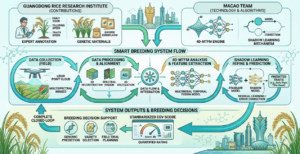
Figure 1. Workflow of the Guangdong–Macao Interdisciplinary Collaboration and Smart Breeding System
Project Highlights and Core Achievements
This study goes beyond conventional algorithms and achieves a qualitative shift from manual observation to intelligent decision-making through the following core strengths:
1.Pioneering 4D multimodal fusion technology:
The system overcomes the limitations of single-sensor approaches by systematically and synchronously integrating geometric structural data from 3D LiDAR with biochemical parameters from multispectral cameras. Through the 4D-MTFM platform developed by the Macao team, the system can automatically capture subtle dynamic changes in rice growth over time, from transplanting to canopy closure, enabling a high-dimensional evaluation of growth vigour.
2.Precise algorithmisation of expert knowledge:
With the in-depth involvement of experts from the Rice Research Institute, Guangdong Academy of Agricultural Sciences, the system embeds real breeding logic, such as the number of days required to reach maximum effective tillering and the leaf-age increase rate. This means that the AI is no longer performing blind calculation. Instead, it “observes” rice in a way similar to an expert with decades of experience, giving its predictions a strong biological basis.
3.Self-evolution of the shadow learning mechanism:
The system features a distinctive shadow learning mechanism. When prediction deviations occur due to complex field conditions or special varieties, the shadow model automatically triggers residual learning and performs a secondary feature scan on error cases. This mechanism ensures that the system possesses exceptional robustness, enabling it to address breeding challenges across different regions and climates.
4.Industry-leading research indicators:
The study has been validated using 300 internationally diverse rice accessions. Key indicators, including tiller number, with R² = 0.86, and leaf-age increase rate, with R² = 0.91, have achieved internationally leading levels of prediction accuracy. Screening efficiency has improved by more than 20 times compared with traditional manual methods.
Research steps
Multi-source data acquisition and spatial alignment (building the digital foundation)
Using UAVs equipped with 3D LiDAR and multispectral cameras, the project builds high-precision digital twin records for field-grown rice during high-frequency growth windows. The algorithm developed by the team can automatically remove noise from complex environments, ensuring precise alignment between the structural and spectral data of each rice plant.
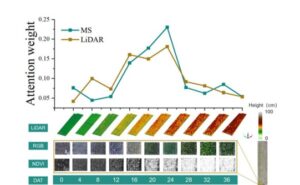
Figure 2. Visualisation of the Temporal Attention Mechanism and the “Golden Window” for Trait Evaluation. The heat map shows how the AI model accurately identifies the critical phenological period from 12 to 20 days after transplanting. This demonstrates that the system can capture early growth inflexion points that are difficult to detect with the naked eye, and that its judgement is highly consistent with expert experience.
Algorithmisation of expert knowledge (embedding breeding expertise)
Experts from the Rice Research Institute, Guangdong Academy of Agricultural Sciences, translate the abstract judgement of “early establishment and rapid growth”, such as tillering speed and leaf-age changes, into 12 specific quantitative indicators. By learning these indicators, the system transforms the “seedling assessment” experience of experts into computable mathematical logic, ensuring that AI evaluation criteria are highly aligned with those of human experts.
4D-MTFM composite network modelling (core computational engine)
The project independently develops a 4D-MTFM composite neural network. Through joint training and adaptive weighting of the loss function, the system deeply fuses spectral features with 3D structural features. It automatically adjusts its focus according to the growth stage, concentrating on the most important growth signals in the same way as an expert observer.
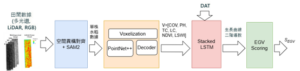
Figure 3. Workflow of the 4D-MTFM Model
Shadow mechanism and intelligent decision-making (error re-learning and output)
The project introduces a shadow learning mechanism to perform a secondary feature scan on complex samples with large prediction deviations, allowing the system to learn from failure and maintain robustness. Ultimately, the system automatically generates a standardised Early Growth Vigour (“EGV”) score on a 100-point scale and provides recommendations for bulk preliminary screening.