





A Sentiment-Driven Prediction Platform for Financial ETFs
Supervisors: Tan Zehan and Cheang Hio Cheng
Student: Chen Yaoguang
I. Brief Introduction
Project Overview
This work is an innovative fintech teaching example, aiming to provide high-precision and interpretable forecasting services for financial exchange-traded funds (“ETFs”) by integrating sentiment analysis and time-series forecasting technology. The platform overcomes the limitations of traditional financial prediction models, achieving a directional prediction accuracy of up to 73%, a significant improvement over conventional models, which typically achieve 50–60%.
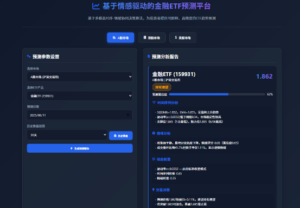
Figure 1. Interface of the Sentiment-Driven Prediction Platform for Financial ETFs
Core Features
- High-accuracy prediction
Directional prediction accuracy: 73%
Continuous prediction error: 0.009 (MAE)
Coverage across A-share, Hong Kong and US stock markets
- Sentiment-driven analysis
Integrating multi-source sentiment data
Dynamic adjustment of sentiment weights
Real-time market sentiment perception
- Explainable AI decision-making
Natural language explanations for 100% of decisions
In compliance with financial regulatory requirements
Transparent decision-making process
- Cross-market coverage
Financial ETFs in the A-share market
Financial ETFs in the Hong Kong stock market
Financial ETFs in the US stock market
II. Technical Features
1.System Architecture Diagram
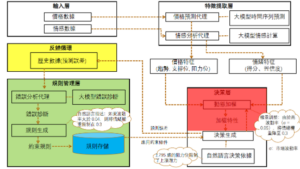
The system architecture of this project begins at the input layer, which is responsible for receiving raw data, including price data (such as real-time quotes, trading volume and historical movements) and sentiment data (such as news, social media content and user reviews). The data then flows to the feature extraction layer, which consists of two core agent modules operating in parallel. The price prediction agent uses a large model to perform time-series analysis and extract key price features (such as trends, support levels and resistance levels). At the same time, the sentiment analysis agent uses a large model for semantic analysis and calculates sentiment features (including sentiment scores and confidence levels). The extracted features are then transmitted to the decision layer, where core dynamic weighted fusion is performed. Based on real-time market conditions (such as volatility), the system adjusts the relative weighting of price features and sentiment features. After applying constraints (such as system rules or technical resistance-level constraints — for example, “the resistance level at 1.795 limits upside potential”), the system ultimately generates prediction results and trading recommendations (such as buy, hold or sell), together with a natural language decision rationale. The system also includes a critical rule management layer responsible for processing historical data from the feedback loop (primarily discrepancies between past predictions and actual market outcomes). This layer performs diagnosis through an error analysis agent. With the assistance of a large model, diagnostic conclusions (such as the natural language statement “if volatility is greater than 0.04, limit the sentiment weight to 0.3”) are converted into specific constraint rules. These rules are then stored in the rule base and called by the decision layer in real time. This feedback loop mechanism continuously feeds prediction errors back into the system, driving system learning and the self-iterative optimisation of the rule base, thereby forming a self-improving closed-loop system.
2. Algorithm Innovations
2.1 Natural language explanation
The system automatically generates human-readable decision logic throughout the entire process (such as “limit the sentiment weight to 0.3 under high-volatility conditions”). It converts complex algorithmic results into natural language explanations to meet the needs of financial compliance review.
2.2 Dynamic weighting mechanism
The system dynamically adjusts the relative weighting of time-series features and sentiment features in the prediction model according to real-time market volatility (σ). For example, under high-volatility conditions, it reduces the sentiment weight (such as by limiting it to 0.3) in order to control the impact of sentiment noise and adapt to different market environments.
2.3 Self-iterative rule base
2.3.1 Automatic generation of explainable rules based on prediction errors
By diagnosing the errors between prediction results and actual market values, the algorithm automatically generates explainable operational rules (such as “when volatility σ > 0.04, set the upper limit of the sentiment weight to 0.3”). These rules are stored in the rule base for use in decision-making.
2.3.2 Rule confidence calculation:
The rule confidence score is calculated based on the proportion of correct predictions out of the historical trigger count of that rule. The algorithm calculates a confidence score for each automatically generated rule, quantifying its credibility as a numerical value.
2.3.3 Rule storage and retrieval
Storage: Rules and their metadata (such as the aforementioned confidence scores, natural language descriptions and trigger conditions) are stored in an SQLite database. This structured storage method facilitates the centralised management, querying and updating of rules.
Retrieval: At a specific stage of the decision-making process (such as the rule application stage), the system retrieves relevant rules from the database based on factors such as current market conditions. For example, when market volatility exceeds 0.04, the system retrieves the rule that limits the sentiment weight and applies it to the decision prompt to guide subsequent decision generation.
2.4 Multimodal fusion
Price features: Trends, support levels and resistance levels
Sentiment features: Score, confidence level and sentiment intensity
III. Application Value
Practical applications in the field of financial investment
Multi-market prediction capability: The platform covers the A-share, Hong Kong stock and US stock markets, providing investors with a global perspective.
Risk management tool: Through validation against actual prediction results, the platform helps investors understand the limitations of the model.
Decision support system: The platform provides confidence assessments. Its accurate predictions in the A-share market demonstrate its strength in domestic market analysis.
Continuous improvement mechanism: The platform continuously optimises model parameters based on prediction errors (including cases from the Hong Kong and US stock markets).
Practical value
Strength in the A-share market: The prediction error for 159931 is only 0.003, demonstrating the model’s strong understanding of the domestic market.
Cross-market learning: Prediction deviations in the Hong Kong and US stock markets reveal the complexity of cross-border factors.
Model transparency: Each prediction provides a detailed analysis of influencing factors and risk warnings.
Business application scenarios
Brokerage investment research support: The platform can provide investment advisers with data-driven references for ETF recommendations.
Fund management tool: The platform can assist fund managers in asset allocation and risk control.
Personal investment assistant: The platform can provide retail investors with professional-grade analytical tools.
Risk control system component: The platform can be integrated into the risk management platforms of financial institutions.
- Social Value
Promoting the healthy development of financial markets
Enhancing market efficiency: Accurate prediction can help guide the rational allocation of capital and reduce irrational investment behaviour.
Enhancing market transparency: Explainable AI decision-making makes investment logic clearer and more transparent.
Reducing systemic risk: Multidimensional analysis helps identify potential market risk points.
Driving fintech innovation: The project provides a new paradigm for combining sentiment analysis with quantitative investment.
Contribution to inclusive financial services
Democratisation of technology: The platform enables ordinary investors to access institution-level analytical tools.
Investment education function: Prediction explanations help cultivate rational investment thinking among investors.
Cross-market connectivity: The platform promotes information flow and resource allocation across global financial markets.
Protection of small and medium-sized investors: The platform provides risk warnings and decision-making recommendations to help reduce investment losses.
Data-driven social progress
Academic research contribution: The project provides an empirical research case for the fields of finance and AI.
Policy formulation reference: The platform provides regulators with tools for monitoring market sentiment and risk.
Driving industrial upgrading: The project encourages traditional financial institutions to move towards digital and intelligent transformation.
Talent development platform: The project provides a practical learning environment for fintech talent.
Supporting the development of Macao as a financial centre
Fintech branding: The project helps enhance Macao’s innovative image in the field of fintech.
Industry–academia–research integration: The project promotes deeper cooperation between Macao’s universities and the financial sector.
Talent attraction effect: The project helps attract fintech talent to Macao.
Regional financial cooperation: The project provides technical support for financial integration in the Guangdong–Hong Kong–Macao Greater Bay Area.
- Educational Significance
Practice of innovative education models
Project-driven learning: The project helps develop students’ ability to solve real-world problems through an authentic prediction project.
Interdisciplinary integrated education: The project integrates knowledge from AI, finance, statistics, psychology and other fields.
Cultivation of an international perspective: By covering three major financial markets, the project helps students develop global thinking.
Innovative thinking training: The project encourages students to move beyond traditional frameworks and explore the possibilities of technological innovation.
Development of research capabilities
Research methodology learning: Students master the complete research process, including data collection, model construction and performance validation.
Critical thinking cultivation: By analysing both successful and unsuccessful prediction cases, students develop objective analytical abilities.
Awareness of continuous improvement: By reflecting on predictions with larger errors, students develop self-iteration and continuous optimisation thinking.
Academic integrity education: By reporting prediction results truthfully, the platform helps cultivate a rigorous academic attitude.
Acquisition of practical skills
Data analysis skills: Students acquire practical techniques in financial data processing, feature engineering and model training.
Risk management awareness: Through cases of prediction failure, students learn methods for risk identification and control.
Cultivation of a business mindset: Students understand how technology can be translated into commercial value and social benefits.
Teamwork ability: Students develop communication, coordination and teamwork skills in an interdisciplinary project setting.
Values education
Technology for good: The project guides students to think about the positive impact of technological innovation on social development.
Sense of social responsibility: The project cultivates students’ sense of responsibility to use professional knowledge to serve society and benefit the public.
A global perspective: Multi-market prediction practice helps students develop international thinking and cross-cultural understanding.
Lifelong learning attitude: Through continuous model optimisation, students experience the importance of lifelong learning.
Innovation in teaching methods
Outcome-oriented teaching: The project is guided by actual prediction results and emphasises the verifiability of learning outcomes.
Case-based teaching: Real market data and prediction cases are used for in-depth teaching.
Interactive learning: Students participate in prediction validation and model improvement, increasing their learning initiative.
Reflective learning: By analysing the successes and failures of predictions, students develop deeper thinking and self-reflection abilities.
Educational resource development
Practical teaching platform: The project provides a reference model for fintech education at other institutions.
Curriculum innovation: The project supports the design and optimisation of fintech-related courses.
Teacher development: The project provides teachers with opportunities for training in frontier technologies and practice-oriented teaching.
A model for university–enterprise cooperation: The project helps build an educational ecosystem featuring deep integration of industry, the university and research.
Educational assessment system
Multidimensional assessment: Learning outcomes are assessed across multiple dimensions, including technical indicators, commercial value and social impact.
Process-oriented assessment: The project emphasises the development of thinking and capabilities during the learning process.
Practice-based assessment: Actual project outcomes and market feedback are used as the basis for assessment.
Developmental assessment: The project focuses on students’ long-term development and capability of continuous improvement.
- Conclusion
The teaching example, A Sentiment-Driven Prediction Platform for Financial ETFs, fully reflects the innovative practice of Macau Millennium College in fintech education. By integrating multidisciplinary technologies such as AI, sentiment computing and financial engineering, the project not only achieves a significant technical breakthrough, with a prediction accuracy of 73%, but, more importantly, provides students with an excellent learning case that combines theory with practice and gives equal weight to technological innovation and social value.
This project has not only driven the application of explainable AI in the financial sector but has also contributed significantly to the cultivation of fintech talent and industrial development in Macao, fully demonstrating the vital role of educational innovation in promoting social progress.